
The largest extant subspecies of the deer family along with the Chukotka moose, the Alaska moose inhabits most of Northwestern North America. While the males have antlers, like many other deer species, they lose their antlers around December & January, and regain them during the spring.
Coniferous Forest Animals
Introduction to Animals in the Coniferous Forest
Despite the often-harsh climates and relatively sparse vegetation, the coniferous forest range is home to countless invertebrates, small and big land animals as well as birds. All the species living here has distinct food habits and special adaptations that enable them to survive.
Some grow thick winter coats to stay warm and move even in deep snow, while others hibernate. Most birds living in these regions are migratory, so, they fly to warmer regions to escape the chilly winters.

Insects of the Coniferous Forest |
| Pine Beetle |
Olive-Sided Flycatcher

Olive-sided flycatcher is a medium to large-sized passerine bird belonging to the tyrant flycatcher family. It is sturdily-built and is one of the most noticeable birds of the coniferous forests of North America.
Yellow-bellied Flycatcher

The Yellow-bellied Flycatcher is a species of small passerines of the tyrant flycatcher family. Its broad range of distribution makes its population relatively invulnerable for some time to come.
Mountain Beaver

Mountain beaver is a species of primitive rodents found in western North America. This stocky burrowing animal is not a true beaver, but was so named because it severs branches and gnaws barks of trees in a way akin to beavers. Characterized by small eyes and ears, rudimentary tail, and curved front claws, the mountain beaver bears resemblance with tailless muskrats and large hamsters.
Roe Deer

Roe deer or Western roe deer is a species of small deer distributed in many places of Europe and Asia. As compared to the female roe deer, males are larger having short and erect antlers with 2 or 3 points. During October-January, the old antlers are shed and replaced by new ones that are covered with vascular ‘velvet’ skin, which supply blood to facilitate the growth.
Pine Warbler

An aptly named bird, the pine warbler is a member of the New World warbler family. With its numbers in a constant upswing, one would expect to spot one with relative ease; sadly though, the bird spends most of its time in pine branches at great heights, often obscured by pine cones and needles.
Mountain Hare

The mountain hare is one of the most widely distributed of the hare species. It is also one of the largest, second only to the European hare. It is highly adapted for the snowy mountainous regions that it inhabits.
California Red-Sided Garter Snake

The California red-sided garter snake or red-sided garter is a subspecies of common garter snakes found in North America. These colorful, medium-sized snakes are considered harmless since their mild neurotoxic venom is not deadly to humans. Despite having enlarged teeth, the garter snakes lack an efficient means of delivering venom since their gums are comparatively larger.
Common Loon

Common Loons, formerly known as Great Northern Loons, are migratory aquatic birds with sharp beaks and thick necks.
Big Brown Bat

Big brown bats are the largest and most common among other bats found in the United States. Although males and females are similar in appearance, females are a bit larger than males. It derives its name because of its large size – almost more than double the size of little brown bats.
American Black Bear

The American black bear is a species of medium-sized bears found in North America. Since its population has grown over the last two decades, it has become the most familiar and widely distributed of all the bear species in America. Despite their name, black bears exhibit variation in coloration. It is believed that this variability is related to the diversity of their habitat, as bears with lighter colors are found in open habitats.
Canada Lynx (Canadian Lynx)

Canada lynx also called the Canadian lynx is a mid-sized cat species ranging across northern parts of the United States, as well as Canada, and Alaska. With a well-developed body and long legs, its hind limbs being a touch longer than the forelimbs, the Canada lynx has a somewhat arched appearance. Similar to other lynx species, these predatory cats have long, dense fur, ruffed face, triangular ears tipped with tufts of hair, and a short, thick tail.
Spruce Grouse

The spruce grouse is a sturdy bird with dark plumage found in the coniferous forests of North America. It resembles a large chicken in its appearance and is nicknamed ‘fool’s hen’.
Pine Grosbeak

Pine grosbeaks are the larger members of the finch family found in the boreal forests. Sexual dimorphism is present among males and females. They are stocky, plump and heavy-chested with strong, short, and cone-shaped bills. The nine recognized subspecies of pine grosbeak vary in body size, bill shape and size, as well as in leg, tail and wing lengths.
North American Porcupine

The North American porcupine is the second largest rodent species found in North America. It is an herbivorous animal with pines, or quills, as they are called, all across their body, except the face, underbelly and limbs.
Mountain Chickadee

Mountain Chickadees are small, stockily-built passerine songbirds with short and strong beaks.
Mountain Horned Lizard

Mountain Horned Lizards or mountain horned dragons are a genus of medium-sized arboreal (tree dwelling) lizards native to Southeast Asia. These reptiles are characterized by a pair of large eyes, and a row of conspicuous dorsal spines at the back of the neck, reaching the tail. These lizards are often bred in captivity or semi-domesticated for the purpose of pet trade, and they make for some fascinating terrarium subjects.
Wood Bison

The largest terrestrial mammal in North America, the wood bison is a dark brown bovine animal with a large head, a high hump on its shoulder, which is covered with long shaggy hair that extends to the front legs. The horns are short and black and tend to curve inward for the males, while being straight in females.
Northern Shrike

Northern Shrike is a species of medium- to large-sized predatory songbirds that spend the summer in the northern territories of Asia and Europe, as well as North America including Canada and Alaska, but they winter south in the temperate regions. These passerine birds are characterized by a large head, a sturdy beak that is curved at the end, and medium-long black tail with white corners.
Asian Black Bear (Moon Bear)

Asian black bear aka the white-chested bear and moon bear is a species of medium-sized bears characterized by a sturdy frame, round head, and rough coat. Although their appearance is similar to brown bears, the black Asian bears have a lighter body, slender limbs, larger nose and lips, smaller skull, and a larger jaw. Their bell-shaped ears are longer as compared to those of their relatives – the American black bear and the brown bear.
White-Nosed Coati (Coatimundi)

White-nosed Coati, also called Coatimundi, is a species of mammals belonging to the raccoon family indigenous to the southwestern North America, Central America, and South America. It has a narrow, elongated head with small, rounded ears and a pointed, flexible snout that is somewhat tilted up while its tail is furry and tapers to the tip. Its face has a dark brown or blackish gray color with white patches occurring around its ears, nose, and eyes.
American Bison
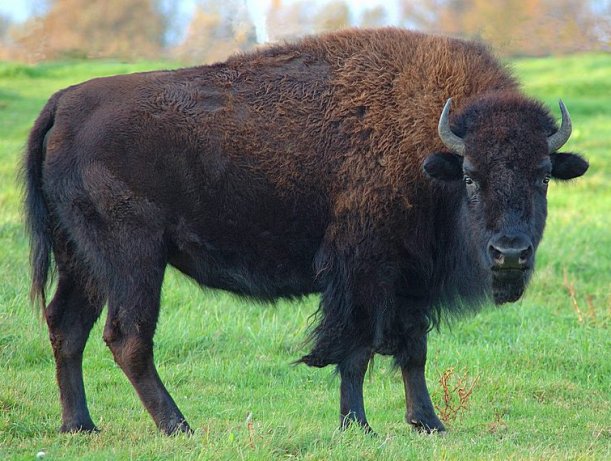
The American bison is a species of large ungulates that are not related to true buffalo species such as the African and the Asian water buffaloes. Their huge, bulky frame is emphasized by a towering hump on their shoulder while their massive head, featuring a wide forehead, a pair of up-curving horns, and straggly facial beard rests on a short, compact neck.
Rough-Legged Hawk

Rough-legged hawk, formerly called the rough-legged falcon, is a moderately large, migratory bird of prey that spends the summer in the Arctic as well as the Subarctic regions, moving south to avoid harsh winters. As compared to its Buteo cousins, including the ferruginous hawk and the red-tailed hawk, the rough-legged raptors can be identified by their smaller bills, broader wings with wide wingtips, and a longer tail.
Woodland Caribou

Woodland caribou or the boreal woodland caribou is the largest subspecies of caribou, a group of mammals belonging to the deer family. These medium-sized ungulates, native to the Northern United States and Canada, are characterized by a compact body with a thick covering of fur, short, wide ears, blunt muzzle, and a tiny tail.
The antlers of woodland caribou are broader, thicker, as well as more compact and flattened compared to those of barren-ground caribou, while their heads and legs are also longer than the latter.
Iberian Lynx

Iberian lynx, the most threatened feline species in the world, is native to the Iberian Peninsula. These medium-sized cats have tufted ears, dense beard-like facial hair, a bobbed tail, and long legs akin to the other species in their genus. However, their reddish-brown or yellowish coat patterned with dark spots is shorter than most other lynxes. Some extinct populations that were native to the western regions of their geographic range had spotless coats.
Eurasian Lynx

The Eurasian Lynx is a species of medium-sized predatory cats found in East and Central Asia, Siberia, Scandinavia, as well as in parts of Europe. It has a strong muscular body and long, powerful legs, with the characteristic stubby “bobbed” tail having a black rounded end. The tips of its large ears have the distinguishing black tufts while its frill of long gray/white cheek hairs gives off an impression of a dense mane.
Hairy Woodpecker

The hairy woodpecker is a small- to medium-sized bird found in the high mountain forests of Central America, as well as both the plains and the mountainous regions of North America. It is a powerful bird for its size, often seen foraging along the branches and tree trunks. Though it has some striking similarities with the downy woodpecker, it has a much larger structure and its bill is longer as compared to the thornlike bill of the downy.
Emerald Tree Boa

Emerald tree boas are non-venomous snakes native to South American rainforests. They earn their name from their emerald green body while the white zigzag “lightning” stripes covering their backs help in distinguishing them from other South American snakes.
American Kestrel

The American kestrel is the smallest falcon of North America and is the only kestrel found in the Western Hemisphere. Even though it has a small body, it is a fierce predator and is usually seen waiting to pounce on its prey in the open country.

Red Breasted Nuthatch

The red-breasted nuthatch is a small songbird that gets its name from its cinnamon under parts. It lives in the coniferous forests of Canada, Alaska, and parts of the United States. This little bird usually stays in its permanent location all through the year, although it sometimes irrupts to the southern regions if there is paucity in their food supply.
Great Grey Owl

The great grey owl is recorded as one of the largest species of owls in the world, found in coniferous forests and mountainous regions in the Northern Hemisphere. These birds are endowed with a large round head and a grey face with yellow eyes encircled with dark circles. The grey feathers all over its body have given this bird its name.
Its fluffy feathers make it look very large, earning the owl its name. Even though it has a large wingspan of up to 60 inches, it is only half as heavy as a snowy owl. Adult owls have a voracious appetite for rodents and can eat large quantities of food measuring around one third of their actual body weight each day.
Brown-Headed Cowbird

The brown-headed cowbird is a small songbird that belongs to the icterid family of passerines. They are native to temperate, and subtropical North America and their range extends from Canada to Mexico. The birds living in the southern parts of North America are permanent residents. However, the birds that inhabit the northern parts of the Western Hemisphere migrate to the southern parts of the United States and Mexico during winter and return to their original dwelling places in March or April.
Western Diamondback Rattlesnake

The western diamondback rattlesnake is a poisonous serpent found in many regions of the United States of America and Mexico. In fact, a large number of deaths caused by snake bites can be attributed to this species.
Western Pond Turtle

The western pond turtle is a small to medium freshwater turtle, found in ponds and streams. This reptile is generally brown or black in color on the upper shell and yellow and black on the lower one. They are found in the western coast of the United States and Mexico. The Canadian Species at Risk Act drafted in May 2002 has identified this turtle as having become extirpated in Canada.
Least Weasel

The least weasel is the smallest species of the weasel family and is also known as only the “weasel” in the United Kingdom. It is the smallest carnivore in the world with a typical long and slender body contour. This mammal has long whiskers, big eyes, relatively short limbs and a short tail.
Meadow Vole

The meadow vole is a common North American mammal that is widely distributed across this continent. It is highly active and lives in burrows dug into the ground. In spite of the fact that they live in locations within close proximity to one another, they constantly fight with other members of the same species. They sometimes damage garden plants, fruit trees and commercial crops.
White-Breasted Nuthatch

The white-breasted nuthatch belongs to the nuthatch family that includes a number of small songbirds. It is found throughout the temperate regions of North America and breeds in the woodlands that are full of old trees.
This bird is endowed with a stocky body consisting of a big head, strong beak, small tail and powerful feet. It has a white face and has a light blue-gray hue on the upper parts of its body. Its ventral side is also white, the top of its head is black and the lower belly is tinged with a chestnut shade.
White-Throated Sparrow

The white-throated sparrow belongs to the American sparrow family and is found all over the coniferous forests of North America. They get their names from their bright white throats bordered by a dark malar stripe.
These beautiful singing birds are also called as Canadian sparrows as they are found all over Canada. They are polymorphic and come in two colors or morphs – the white-striped and the tan-striped, which makes them even more distinctive and special.
American Marten

The American marten is a North American mammal of the weasel family. This predator is also known as the “pine marten”; this name is derived from the common but distinctive martens that are found all over Eurasia. It is smaller and has a lighter color than the fisher (Martes Pennanti).
This small animal has golden brown fur with a yellow chest. It has a long and slender body with large eyes. Their small rounded ears resemble those of cats and they also have sharp, curved claws.
Long-Eared Owl

The long -eared owl is a common species of owl widespread along the Northern Hemisphere. This bird is found throughout Europe and North America with some of them migrating to parts of Asia during the winter months. The so called “ears” of the long-eared owl are just tufts of feathers located above its head with the real ears of this bird actually hidden behind the feathers on its head.
Western Tanager

The western tanager is a medium-sized songbird found in the western regions of the United States. The adult male of this species has attractive orange-red and yellow plumage with an articulate voice and singing pattern similar to the American Robin. They prefer living in coniferous forests that they consider to be their natural abode.
Western Fence Lizard

The Western Fence Lizard is a reptile that is often seen scurrying along the shrubs and trees of the woods in the western states of America. They are very common in coniferous forests that form part of their natural habitat. One can also keep them as pets, but they need special care.