
The Norway spruce is a beautiful ornamental tree species. The pyramid-shape makes it as a viable choice for Christmas trees. It is also a popular selection for bonsai.
Spruce
Spruce is any of the large, coniferous tree species belonging to the genus Picea of the family Pinaceae, distributed across the temperate and boreal regions in the Northern Hemisphere. These trees can be identified by the four-sided needles and the cones that hang downwards after pollination.

Scientific Classification | |
| Kingdom | Plantae |
| Clade | Tracheophytes |
| Division | Pinophyta |
| Class | Pinopsida |
| Order | Pinales |
| Family | Pinaceae |
| Subfamily | Piceoideae |
| Genus | Picea |
List of Different Types of Spruce Trees
The Picea genus includes thirty-five extant species, out of which the Brewer’s spruce has a basal position, after that come the Sitka spruce, and then the other species. All these species are classified into three clades, as given below.
Clade I
- Brewer’s spruce (Picea breweriana)
- Sitka spruce (Picea sitchensis)
- Engelmann spruce (Picea engelmannii)
- White spruce (Picea glauca)
Clade II
- Sargent’s spruce (Picea brachytyla)
- Chihuahua spruce (Picea chihuahuana)
- Burmese spruce (Picea farreri)
- Likiang spruce (Picea likiangensis)
- Martinez spruce (Picea martinezii)
- Maximowicz spruce (Picea maximowiczii)
- Taiwan spruce (Picea morrisonicola)
- Veitch’s spruce (Picea neoveitchii)
- Caucasian or Oriental spruce (Picea orientalis)
- Purple cone spruce (Picea purpurea)
- Schrenk’s spruce (Picea schrenkiana)
- Morinda spruce (Picea smithiana)
- Sikkim spruce (Picea spinulosa)
- Tiger-tail spruce (Picea torano)
- Wilson’s spruce (Picea wilsonii)
Clade III
- Norway spruce (Picea abies)
- Alcock’s spruce (Picea alcoquiana)
- Dragon spruce (Picea asperata)
- Qinghai spruce (Picea crassifolia)
- Glehn’s spruce (Picea glehnii)
- Jezo spruce (Picea jezoensis)
- Korean spruce (Picea koraiensis)
- Koyama’s spruce (Picea koyamae)
- Black spruce (Picea mariana)
- Meyer’s spruce (Picea meyeri)
- Siberian spruce (Picea obovata)
- Serbian spruce (Picea omorika)
- Colorado spruce or blue spruce (Picea pungens)
- Green dragon spruce (Picea retroflexa)
- Red spruce (Picea rubens)
In addition to these spruce species, several cultivars exist including ‘Dwarf Alberta Spruce’, ‘Black Hills Spruce’, ‘Coerulea’, ‘Echiniformis’, ‘Jean’s Dilly’, ‘Pendula’, ‘Pixie’, and ‘Rainbow’s End’.

Quick Information | |
| Tree Type | Evergreen coniferous |
| Identification | Height: 60-200 ft Leaves: Linear, spirally-arranged, needle-like, about 1 inch long Trunk Diameter: 0.5-2 ft Bark: Thin, scaly, gray to reddish-brown Female Cones: Drooping, ovoid or cylindrical, green to purple when young, pale to dark brown when matured Seeds: Winged, with 5-10 cotyledons Branches: Whorled Crown: Conical to spirelike Pollen cones: Single/grouped, oblong, auxiliary, yellow to purple |
| Distribution | Western and Northern North America, Mexico, Europe, Asia |
| Habitat | Mountainous regions, boreal forests |
| USDA Hardiness Zone | 2-8 |
| Growth Rate | Fast, 30-60 inches annually |
| Lifespan | Long-lived, varies depending on the species, some can live for 1000 years |
| Growing Conditions | Sunlight: Prefers full sun, but also tolerates shade Soil: Loam, sandy, clay, well-drained Water: 1-3 inches every week when rainfall is low |
| Drought Tolerance | Moderate |
| Diseases & Pests | Shoot blight, needle cast, and stem canker caused by the fungi Sirococcus, Rhizosphaera kalkhoffi, and Valsa kunzei respectively, eastern spruce budworm is a pest of white and black spruce |
| Reproductive System | Monoecious |
| Propagation | From stem cuttings |
| Wildlife Value | Deer mice, mountain voles, chipmunks, and red-backed vole eat spruce seeds, red squirrels feed on its flower buds |
| Uses | As pulpwood for making paper, building wood, tonewood for mandolins, guitars, violins, pianos, and cellos, ornamental Christmas trees; shoots are the source of vitamin C, for making spruce beer from branches and leaves |
| IUCN Conservation Status | Species like Norway spruce, blue spruce, and white spruce are listed as Least Concern, while Serbian spruce is considered Endangered |
Interesting Facts
- The spruce tree is symbolically used in the coat-of-arms of the Finnish town of Kuhmo.
- Spruce needles fall off when the tree is 4-10 years old. However, the peg-like structures (called sterigmata or pulvini) on the branches are retained, making them rough.
- The Wright brothers constructed the first aircraft, called Wright Flyer, using spruce wood.
- Captain Cook prepared an alcoholic sugar-based beer from branches, needles, and buds of spruce trees during his voyages and gave it to his crew for preventing scurvy.
- A Norway spruce named Old Tjikko is the oldest clonal tree, having an age of 9,550 years.
References
- https://oregonstate.edu/trees/ conifer_genera/spruce.html
- https://www.conifers.org/ pi/Picea.php
- http://biorefinery.utk.edu/ technical_reviews/Tree%20Size.pdf
- http://hort.uconn.edu/ detail.php?pid=310
- https://web.archive.org/web/ 20040405082131/http:// www.nasm.si.edu/ exhibitions/gal100/wright1903.html
Blue Spruce

The blue spruce is an extremely resilient species that can withstand massive temperature changes, air pollution, and draught. They belong to the pine family.
Red Spruce

Red spruce trees inhabit eastern North America. Perhaps it’s most well-known use is its effectiveness as a tonewood, which makes it a perfect choice for making guitars and violins. The tree is, however, susceptible to windthrow and acid rain, both of which can damage it rather easily.
White Spruce

The white spruce tree, also known as cat spruce and skunk spruce, is a coniferous tree found across North America.
Sitka Spruce

What is Sitka spruce?
Named after the Sitka community in Alaska, the Sitka spruce is a species of large evergreen conifers found in the western coastal regions of North America at an elevation of 400-1000 m. Being the third tallest coniferous tree species in the world, the Sitka spruce is known to reach over 90 meters in height.
Engelmann Spruce

Engelmann spruce is a medium- to large-sized evergreen conifer indigenous to the western parts of North America, typically growing at high altitudes between 3,000 ft and 11,980 ft (900 m and 3,650 m). These spruce trees have a pyramidal crown with a slightly rounded top and their branches extend to the ground, giving the whole tree a low, shrubby look.
Serbian Spruce
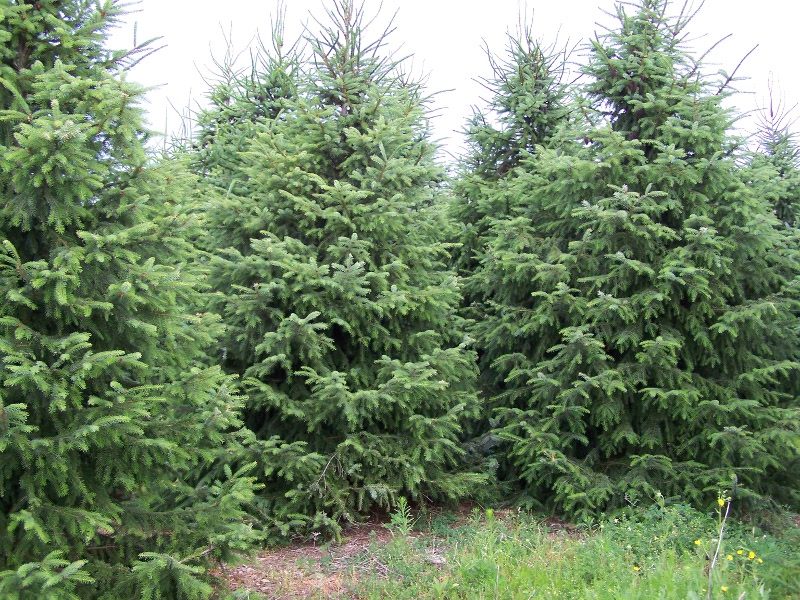
The Serbian Spruce, distinguished by its tapering form and needle-like leaves, is a species of medium-sized coniferous tree found in the mountainous regions along the Drina River valley of eastern Bosnia and western Serbia at an elevation of 2,625-5,249 ft. It has dark foliage with blue-green undersides, and its buff-brown shoots are quite hairy.